Home/Insights/PPC Paid Advertising
Before you spend another pound on ads, fix the foundations.
In this article
Here’s a pattern we see more than any other. A business decides it needs more leads, so it runs some ads. Google, Meta, maybe both. Things tick along. There are results, enough to keep going, but it never really takes off. So the budget goes up. A new agency comes in. A different platform gets tested. And the results stay roughly where they were.
If that sounds familiar, the good news is that you probably don’t have a budget problem, a platform problem or an agency problem. You almost certainly have a foundations problem. And until that’s fixed, spending more on ads won’t change much.
Ads are an amplifier, not a fix
It helps to be clear about what paid advertising actually does. Ads take what you already have and turn up the volume. If what you have is working, that’s brilliant. More of the right people see a clear offer, land on a page that converts and get in touch. The maths works and scaling is just a question of how much you want to spend.
But if the foundations are shaky, all an ad does is pay to send people into something that doesn’t convert, doesn’t build trust and doesn’t give them a reason to choose you. You’re not buying growth. You’re buying a faster way to find out the website isn’t ready.
That’s why “more” is almost never the answer when ads underperform. More reach, more spend and more channels all amplify the same weak system.
The seven foundations to check first
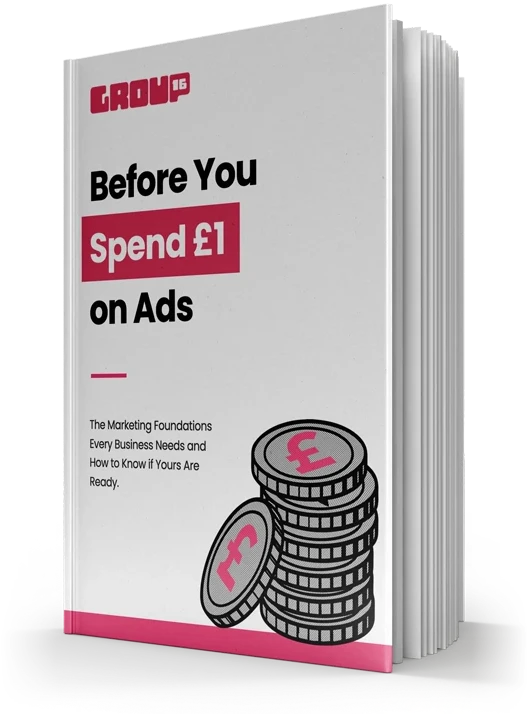
We wrote a short guide on this called Before You Spend £1 on Ads, and these seven foundations are the heart of it. None of them need to be perfect. They need to be working well enough that the marketing you layer on top has a fighting chance.
1. Positioning
Positioning is being clear on three things. Who your business is for, what you actually do and why someone should choose you over the alternatives. It sounds obvious, and most businesses would say they have it covered. Spend five minutes on the average company website and you’ll see that most don’t, not really.
Vague positioning sets off a chain reaction. Your ads attract the wrong people. Your website speaks to everyone and converts no one. Sales conversations drag on because you’re explaining yourself from scratch every time.
A quick test. If your homepage headline could sit on a competitor’s website without anyone noticing, your positioning needs work.
2. Messaging
Positioning is the strategy. Messaging is how you say it. Good messaging translates what you stand for into language that lands with the people you’re trying to reach. It’s specific, it’s about outcomes and it’s written the way your customers think, not the way your business talks about itself.
Most businesses describe what they do. The strong ones communicate what the customer gets. “We provide comprehensive digital marketing services” and “we help businesses stop wasting money on marketing that doesn’t perform” could describe the same company. Only one of them makes you want to read on.
Weak messaging is one of the most invisible forms of commercial leakage, because nothing is technically wrong. It’s just not compelling enough to make anyone stop.
3. Website conversion
Your website isn’t a brochure. Its job is to take someone who lands on it and move them towards doing something. Every pound you spend on traffic runs through it, which makes a website that doesn’t convert one of the most expensive problems a business can have. You never get a bill for it. You just quietly lose the enquiries you never knew were there.
The usual culprits are pages that take more than three seconds to load, headlines that talk about the business rather than the visitor, no obvious next step, social proof buried at the bottom, contact forms that ask for far too much and a mobile experience that feels like an afterthought.
None of these are design problems. They’re commercial problems.
4. Trust signals
People don’t buy from businesses they don’t trust, and a surprising number of businesses invest almost nothing in building trust, then wonder why conversion is lower than it should be.
When someone finds you, they run a quick and mostly unconscious check on whether you’re the real deal. They’re looking for evidence that other people have worked with you and had a good experience. If that evidence isn’t there, most won’t ask for it. They’ll just move on to a competitor who looks more credible, even if that competitor isn’t better at the job.
Reviews, case studies, client logos, accreditations and a team page with real photos all do this work. Trust isn’t built by claiming expertise. It’s built by showing it.
5. Brand consistency
Wherever someone meets your business, it should feel like the same company. Website, emails, social, print, proposals, vans, signage. Same logo, same colours, same tone, same standard.
Inconsistency is something people notice without being able to say why. A strong website next to scrappy social media. Proposals built in a generic Word template. A logo that exists in six slightly different versions. No single thing is catastrophic, but together they say the business doesn’t quite have its act together, and that’s enough to lose someone before a conversation starts.
6. Channel fit
Not every business needs to be on every platform, but plenty are trying to be, and spreading themselves thin in the process. Channel fit is making a deliberate decision about where your audience actually spends time and what kind of content works there.
The classic mistakes are a B2B business pouring effort into Instagram while ignoring LinkedIn, a local service business running national Facebook campaigns, or a visually led product that has never touched Pinterest. Energy goes into channels that don’t reach the right people, with the wrong content, at the wrong point in the buying journey.
7. Google visibility
This one goes wider than traditional SEO. It’s how well your business shows up when someone who needs what you offer goes looking. Organic search, local results, your Google Business Profile, maps, reviews and the content that surfaces when people ask questions about your sector.
Organic visibility is slow to build but it compounds. Every review, every well-structured page and every piece of useful content adds to something that keeps working whether you’re spending or not. Paid visibility is instant, but it’s rented. The moment the budget stops, so does the visibility.
Paid vs organic: what you’re actually buying
It’s worth sitting the two side by side, because the comparison explains why foundations matter so much.
| Paid advertising | Organic visibility | |
|---|---|---|
| Speed | Live within days | Months to build |
| Cost model | Pay per click, every time | Upfront effort, then it keeps working |
| What happens when you stop | Visibility ends immediately | Visibility continues and usually keeps growing |
| Control | High. You choose terms, audiences and budget | Lower. You earn it rather than buy it |
| Dependency | Permanent, if it’s your only source of enquiries | Low. It becomes an asset the business owns |
| Where it breaks | Weak landing pages, poor tracking, wrong audience | Thin content, technical faults, no reviews |
Neither is better. A healthy business usually runs both. The point is that paid works best as the accelerator on top of an organic base, not as a substitute for one. A business that relies entirely on paid media to be found is permanently dependent on that spend just to stay visible.
The modern layer most businesses haven’t caught up with
Everything above still matters. But the environment those foundations sit in has shifted, and most businesses haven’t noticed yet.
Five years ago, search was predictable. Someone typed a query, got ten blue links, clicked one or two and decided from there. Increasingly, that isn’t how it works. People ask full conversational questions and get direct answers, from Google’s AI Overviews, from ChatGPT and Perplexity, from voice assistants. Instead of ten links they get one answer, and that answer often arrives without a click or a visit to your website.
This is where answer engine optimisation (AEO) and generative engine optimisation (GEO) come in. AEO is about structuring your content so it surfaces in direct answers. GEO is about how your business appears, or doesn’t, when an AI tool is asked who to use. A meaningful number of businesses are going to realise in the next few years that part of their audience already made a shortlist using an AI tool, and they were never on it.
The reassuring part is that strong foundations help here too. Clear positioning makes it easy for an AI model to categorise what you do. Trust signals and consistent brand citations across the web are exactly what those models look for. If your foundations are solid, you’re in a far better position to be visible wherever attention goes next. We’ve written more on this in What AI search means for the traffic you already have.
What to do before you increase the budget
If you’re about to spend more on ads, or you’ve been spending for a while without much to show for it, here’s the order we’d work in.
- Check the tracking. If conversions aren’t being recorded properly, every decision made from the data is wrong, and the ad platform is optimising towards the wrong thing. This is the first thing we check on any account, and it’s wrong more often than you’d think.
- Fix the landing page. The page an ad sends people to should continue the conversation the ad started and ask for one thing. Sending paid traffic to your homepage wastes most of it.
- Sort the trust signals. Reviews, case studies and real photos on the pages traffic lands on. This is quick and it moves conversion.
- Tighten the message. Make the headline about the visitor and what they get. If it could belong to a competitor, rewrite it.
- Then scale. Once the system converts, more budget buys more results. Before that, it buys more disappointment.
A quick readiness check
Before you spend, ask yourself:
- Could a stranger land on your website and understand who you help, what you do and why you’re the right choice within ten seconds?
- Is there a clear, obvious call to action on every key page?
- Do you have visible reviews or testimonials, and a case study from the last twelve months?
- Do your website, emails, social and printed materials all look like the same business?
- Do you know which channels your best customers actually use?
- Do you show up on the first page of Google for your core services in your area?
- Is your conversion tracking verified, so you know what each pound actually brought back?
If you answered no to more than a couple, that’s where the budget should go first.
Frequently asked questions
Should I stop running ads while I fix the foundations?
Usually not. Keep them running at a level you can afford to learn from, and fix the foundations alongside. The ads will tell you quickly whether the fixes are working, because cost per lead will start to fall.
How do I know if it’s the ads or the website that’s the problem?
Look at the click-through rate and the conversion rate separately. A healthy click-through rate with a poor conversion rate means people like the ad and don’t like what they land on. That’s a website problem, not an ad problem.
How long does it take to fix the foundations?
Tracking, landing pages and trust signals can be sorted in weeks. Positioning and organic visibility take longer. The quick fixes often pay for the slower ones.
Does this apply to B2B as much as ecommerce?
Yes. The foundations are the same. The conversion action is an enquiry or a download rather than a checkout, but the logic doesn’t change.
Want to know where you stand?
We’ve put all of this into a short guide, Before You Spend £1 on Ads, along with a free five-minute audit that scores your business across the seven foundations and tells you what to fix first. No hard sell, just a straight view of where you are.
PDF, 20 pages, 4.4MB
Or if you’d rather talk it through, get in touch and we’ll have a look at your account and your site together.